Fiscal and Financial Planning Guide 2024-2025
Workers > Tax Free Savings Account (TFSA)
The TFSA was established in 2009.
The purpose of the plan is to encourage Canadians to make more savings.
How the TFSA works
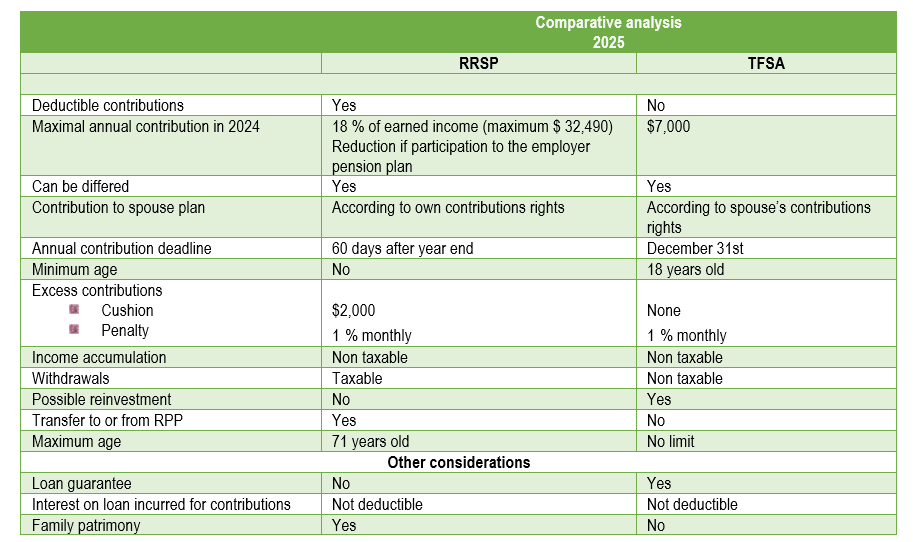
Unlike RRSPs, contributions are not tax deductible and withdrawals will not be taxable. Investment income (interest, dividends, capital gains) earned in the TFSA accumulates tax-free and can be withdrawn tax-free.
Contributions
The annual TFSA limit is $7,000 in 2026. The cumulative limit since its introduction in 2009 is therefore $109,000 in 2026 as illustrated in the following table.
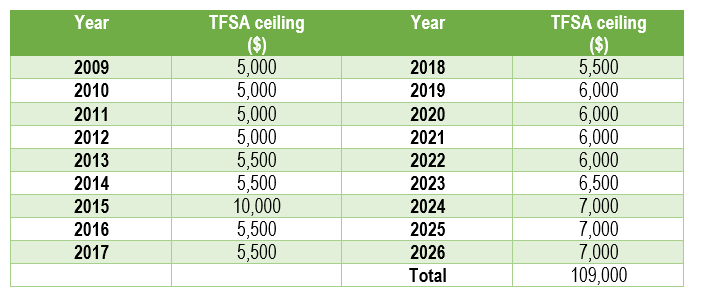
Unused contributions can be reported in future years.
The minimum age to contribute is 18 years old but there is no maximum age. A retiree of more than 71 years of age can contribute to a TFSA even if it can no longer contribute to an RRSP.
Contributions exceeding the allowed maximum are subject to a 1 % monthly penalty on each dollar in excess. There is no $2,000 cushion like in the case of the RRSP.
It should be noted that RRSP’s and TFSA’s are independent plans and contributions can be made to either one without influencing the amounts that can be contributed for the other plan.
Withdrawals
Amounts withdrawn from a TFSA are not taxable (neither the invested capital, nor the accumulated investment income).
Amounts can be withdrawn at any time from a TFSA. There is no minimum period of detention for investments in the TFSA to benefit from the non-taxation of the invested income at the time of withdrawal.