
Fiscal and Financial Planning Guide 2024-2025
Workers > Registered retirement savings plan (RRSP)
The RRSP was introduced in 1957 at the federal level and in 1959 in Quebec.
Maximum deduction
The maximum deduction for 2025 is $32,490. It is calculated as 18% of the previous year’s earned income.
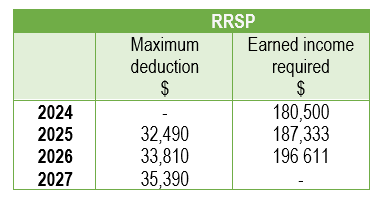
The earned income required in 2026 is $196,611 to maximize the RRSP of $35,390 in the following year, 2027.
If you are a member of a Registered Pension Plan (RPP) or an Individual Pension Plan (IPP) or a Deferred Profit Sharing Plan (DPSP), the maximum RRSP contribution will be reduced by the Pension Adjustment (PA) in box 52 of your federal Employment Tax Slip (T4).
Earned income
Earned income for the purpose of calculating the RRSP contribution consists primarily of:
- Employment income
- Self employed income
- Rental income
Investment or retirement income are not considered as earned income.
Spousal RRSP
An individual can contribute based on his own contribution room to their spouse’s RRSP. He will benefit from his RRSP deduction and the spouse will be taxed on the withdrawal at retirement. This strategy can be beneficial if the spouse is expected to have a lower income at retirement. It should be noted that if the spouse is a common-law spouse, the spousal RRSP contribution is in fact a gift to the spouse that he or she will keep in case of separation.
End of RRSP
The RRSP matures in the year the individual turns 71.
At the latest in the year an individual is aged 71, the RRSP must be transferred to a Registered Retirement Income Fund (RRIF) or can be used to purchase an annuity.