
Fiscal and Financial Planning Guide 2024-2025
Families > Registered education savings plans (RESPs)
The purpose of the RESP is to help families save for their children’s post-secondary education.
The RESP was created in 1974, but it became popular only in 1998 when the federal government began to pay grants on contributions made by parents and Quebec followed suit.
Contributions
RESP contributions are not tax deductible and may be withdrawn tax free when the children begin their post-secondary education. It is a bit like a loan that parents make that will be repaid later.
The lifetime contribution limit is $50,000 per child. Of this amount, $36,000 will be eligible for grants and $14,000 will be non-grantable.

Canada education savings grant (CESG)
The maximum annual contribution eligible for a grant is $2,500 for a maximum annual grant of $750.

The cumulative grant amount is limited to $36,000 for a total grant of $10,800 ($36,000 x 30%).

Accumulation example
If you start contributing annually $2,500 in the year of the child’s birth, up to age 15 for a total of $36,000, the total accumulated value assuming a 5% return will be $73,379 at age 18 and $84,945 at age 17.

If you haven’t contributed for certain years, you can catch up on contributions eligible for a grant, but only one year at a time. For example, you could contribute $5,000 in a given year, i.e. $2,500 for the current year and $2,500 for a catch-up year, and receive a grant of $1,500 (2 x $750).
Contributions are eligible for grants up to the age of 17 of the child.
The child age limit to open an RESP and be eligible for grants is 15 years.
Additional grant
The grant rate on the first $500 contribution may be higher if family income is less than $111,733 for an additional grant up to $150.
Maximum cumulative subsidies will however remain at $10,800.
Canada learning bond (CLB)
Families with a net family income of less than $55,867 can benefit from the $500 Canada Learning Bond (CLB) when the plan opens and $100 annually up to a maximum of $2,000.
If is not necessary to contribute to be eligible for the Bond.
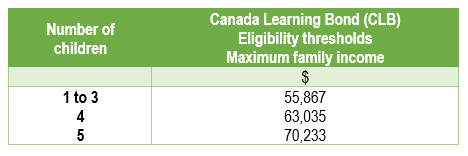

Automatic enrolment in the CLB
To help low-income families, the federal government announced in the 2024 budget its intention to automatically open an RESP in 2028-2029 for eligible children if the family has not yet opened a plan before the age of 4, and to deposit Canada Learning Bonds into the plan.
The federal government will deposit $800, i.e. $500 for the first year of eligibility and $300 for each of the three years up to age 4 ($100/year).
Thereafter, the federal government will contribute $100 per year until the age of 15, for a grand total of $2,000.
According to the government, 130,000 children will receive the CLB each year as a result of automatic enrolment.
Strategies during the accumulation period
Based on the previous rules, here are some planning ideas:
- If you start contributing as early as the child’s year of birth and contribute $2,500 annually, you will benefit of the maximum grants of $10,800 by age 15 after having contribute a total of $36,000.
- Contributions must begin no later than at child’s age of 10 in order to receive the maximum grants of $10,500 and you will need to double the annual contribution to $5,000 until age 17.
- If you have never contributed to the plan and your child reaches the age limit of 15 to set up an RESP, it may still be interesting to open an RESP at age 15 and contribute $5,000 per year for 3 years until age 17. This will qualify for $4,500 grants ($1,500 x 3) that could be used in the short term when the child begins post-secondary education.
- Sometimes grandparents will make the first RESP contributions for their grandchildren. In this case, it is often preferable to open the RESP’s in the parent’s name instead of grandparent’s name. If the grandchildren do not pursue their studies, the accumulated income can be used to contribute to the parents’ RRSP, which would generally not be possible for grandparents because their RRSP would have been converted to a RRIF at age 71.
- It is generally more advantageous to set a family plan for all children rather than individual plans for each child. Indeed, in a family plan, the accumulated income can be attributed to each child according to his education cost which may be different from one child to the other (e.g.: a child studies in Montreal and stays at home and another child studies in the United States). Also, if a child no longer goes to school, the accumulated investment income could go to other children who continue their studies, although grants for the child who did not attend school could be lost.
Withdrawals from RESP funds during studies
- Eligible studies
- Funds accumulated in an RESP can be used for children’s post-secondary education generally at the following educational institutions:
- Universitie
- CEGEP
- Colleges offering a Diploma of Vocational Studies (DVS)
- Funds accumulated in an RESP can be used for children’s post-secondary education generally at the following educational institutions:
- Contributions reimbursement to parents
- Parental contributions can be withdrawn from the RRSP by parents without tax as they were not deducted. They do not necessarily have to be used for children’s studies and could be used for other purposes.
- Grants and accumulated income
- These amounts are taxable on children’s tax returns as they are withdrawn. They may, however, be administered by the parents. The maximum withdrawals for the first trimester of studies is $8,000.
- The financial institution managing the RESP will generally require proof of enrolment in an eligible program of study before disbursement of funds. If the withdrawal for a year exceeds $22,000, the institution could also request a study estimates.
If the child doesn’t undertake post-secondary education?
When the RESP has been in existence for 10 years or more and the child reaches the age of 21 and has not undertaken a post-secondary education it is permitted from that point on to use the accumulated income to contribute to the RRSP of the parent(s) who have set up an RRSP based on the usual RRSP contribution room.
