
Fiscal and Financial Planning Guide 2024-2025
Families > Infertility, adoption and surrogate mother
The infertility treatment tax credit was introduced in Quebec in 2000.
The maximum eligible expenses are $20,000 and the credit rate varies from 20% to 80% based on family net income.

Eligible Expenses
The main expenses eligible for the credit are:
- Fees for in vitro fertilization (IVF) or artificial insemination treatment provided by a doctor and not reimbursed by RAMQ;
- Fees for assessment by a psychologist or social worker;
- Medical expenses prescribed by a physician.
It should be noted that since November 2021, the RAMQ can, under certain conditions, reimburse one IVF cycle and up to six artificial inseminations.
Credit for adoption expenses
The credit for adoption expenses was introduced in 1994 in Quebec and in 2005 at the federal level.
The maximum amount of the credit is $12,371 per child for expenses in the order of $20,000.
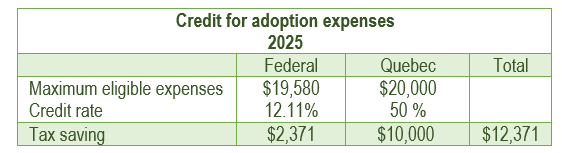
The main eligible adoption expenses are:
- Legal fees related to an adoption order;
- Travel expenses;
- Mandatory fees paid to a foreign or provincial institutions;
- Payments to an adoption agency.
Surrogate mother
In Canada, it is illegal to pay any consideration (e.g. remuneration) to surrogate mothers. However, surrogate mothers may be reimbursed for certain expenses by the future parents under the Assisted Human Reproduction Act.
Permitted expenses
Permissible expense reimbursements are listed in Article 4 of the Reimbursement for Assisted Reproduction Regulations (RRRPA), which lists some fifteen types of expenses that may be reimbursed, but which are not, however, deductible for the parents with the exception of medical expenses paid for the surrogate mother.
For example:
- Legal services
- Travel expenses
- Maternity clothing
- Medical expenses
- Etc.
Deductibility for parents of surrogate mother’s medical expenses
The 2022 Federal Budget broadened the notion of patient to allow future parents to claim a medical expense credit for reimbursements made to a surrogate mother for eligible medical expenses incurred by the latter, excluding other expenses (e.g. legal services) provided for in
section 4 of the RRRPA.
Revenu Québec
Revenu Québec also allows future parents to deduct as medical expenses reimbursements in excess of $20,000 for medical expenses incurred by the surrogate mother.
Foley decision
In the Tax Court of Canada case of Mark G Foley v. Her Majesty, rendered on December 2, 2021, the parents argued that expenses incurred for a surrogate mother should qualify for the adoption credit, which has a broader list of eligible expenses (e.g., legal fees), and that this exclusion was discriminatory. Among other things, they had claimed legal fees that qualified for the adoption credit but did not qualify as medical expenses.
The tax authorities argued that the purpose of the adoption tax credit was to help children get adopted, and that it was designed to encourage domestic and international adoptions of vulnerable children.
The Court concluded that there was no discrimination and confirmed that the adoption tax credit could not be granted in the case of surrogacy expenses. To date, the case has not been appealed and is expected to set a precedent.
