
Fiscal and Financial Planning Guide 2024-2025
Elders > Tax Credit For Home-Support Services for seniors (70 years old or more)
The purpose of this credit is to help people aged 70 and older who live in their dwelling (e.g., house, condo, seniors residence or apartment) by granting them a tax credit on certain expenses.
Credit rate
The base credit rate was 35% in 2021 and is increased by 1% per year up to 40% in 2026 (39% in 2025).

Eligible Expenses
Homeowners (house, condo)
The main eligible expenses are:
- Services related to routine domestic chores (e.g., housekeeping) and outdoor work (e.g., mowing the lawn, cleaning the windows);
- Maintenance of appliances;
- Cleaning carpets and upholstered furniture;
- Cleaning air ducts and chimney sweeping;
- Supply service (grocery and prescription drug delivery);
- Services related to daily activities (e.g., dressing, hygiene, meal preparation);
- Nursing services;
- Condo fees share attributable to current expenses (ask manager for a report).
Tenants
The maximum eligible monthly rent for tenants of a rental property is $ 1,200 (with a minimum of $ 600). The credit rate is 5% for a relatively modest annual maximum tax saving of $ 281 (5% x $ 1,200 x 12 months x 39%).
Managers will usually apply directly to the government for the credit to be paid monthly to the resident. A Relevé 19 will be issued by the government, and the credit received in a given year must be entered on the tax return.
Seniors’ residences
In the case of senior residences, residence managers must allocate a predetermined percentage of rent to eligible expenses based on the services provided under the lease, as established by the Agence du revenu du Québec, as illustrated in the table below.
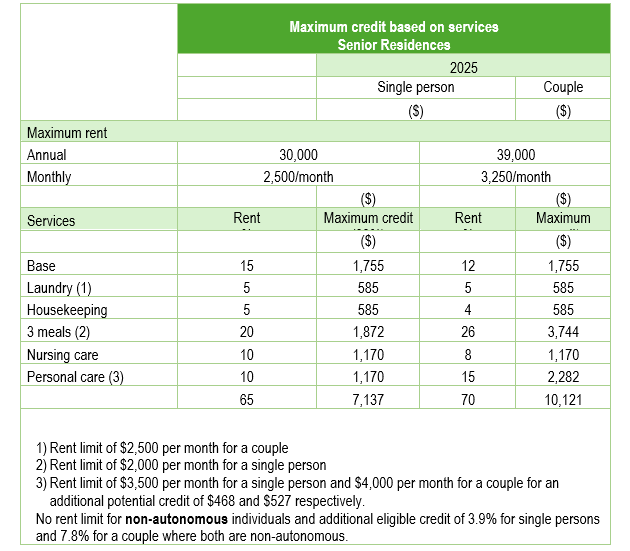
Maximum expenses

Reduction of credit based on family income
The credit is reduced by 3% of the amount of family income in excess of $ 71,010 and by 7% of family income in excess of $ 115,035. Unfortunately, many clients no longer qualify for the credit because of their high family income.

The following table shows the minimum amount of expenses required for autonomous seniors to become eligible to the credit considering family income.

Dependent persons
For the purpose of the Home-Support Tax Credit, a person is considered to be dependent if he or she:
- needs assistance on a regular basis for personal needs (washing, dressing, personal mobility or eating)
- has a serious mental disorder (e.g., Alzheimer’s, dementia, etc.)
The status has to be confirmed by:
- a written attestation from a physician or nurse;
- or TPZ-1029.MD.A form completed and signed by a physician or nurse.