
Fiscal and Financial Planning Guide 2024-2025
Elders > Caregivers
The aging population and the pandemic have led many families to have to care for a loved one with limitations, whether physical or mental in nature. This dedication generally comes with its share of responsibilities and can require a great deal of time and money. Consider, for example, a person caring for a parent with Alzheimer’s disease or for their severely disabled child.
Fortunately, governments recognize this contribution by offering certain tax relief measures to support caregivers. Indeed, in recent years, both the federal government and the Government of Quebec have introduced various tax credits for informal caregivers.
Federal (Canadian Caregiver Credit)
At the federal level, you can claim a caregiver tax credit for the following individuals suffering from a physical or mental impairment:
- Spouse
- Minor child
- Eligible dependent relative (e.g., child, brother, sister, parents)
The person does not need to qualify for the Disability Tax Credit (DTC), but the dependent must have a physical or mental impairment and you must be able to provide a letter from a physician confirming the nature of the physical or mental impairment.
It is not necessary for the person to live with the caregiver.
Spouse
The credit is based on the higher of the following amounts:
- Method 1: $2,687 added to the dependent tax credit and reduced by the dependent’s net income
- Method 2: $8,601 reduced gradually when the dependent’s net income exceeds $20,197 and is reduced to $0 when the net income reaches $28,798.
The table illustrates the case of a spouse suffering from an impairment who has a net income of $12,000.
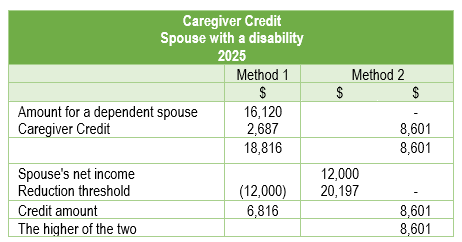
The person will be able to claim the higher credit of $ 1,042 ($8,601 x 12.11%) under Method 2, as it is higher than the one under Method 1 ($ 6,816).
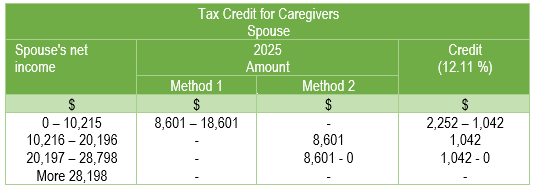
The following table shows the maximum credit amount that can be claimed based on a spouse’s income.
Minor Child
Let us first recall that there is no longer a dependent tax credit in the case of a minor child. This credit had previously been abolished upon the introduction of the new Canada Child Benefit system, which was considerably more generous than the previous system.
- Single-Parent Family
In the case of a single-parent family where the parent is able to claim a dependent tax credit equivalent to that of a spouse ($ 18,876), the calculation is performed in the same way as in the previous case of a spouse.
It should be noted that in order to be entitled to the spouse credit equivalent in the case of a minor child, the single parent must not be paying child support to the other parent.
- Common-Law or Married Couples
In this case, there is no longer any dependent tax credit for a minor child.
The caregiver tax credit will be $2,687 and is not reduced by the child’s income.
Canadian Caregiver Credit Calculator:
Québec (Tax Credit for Caregivers)
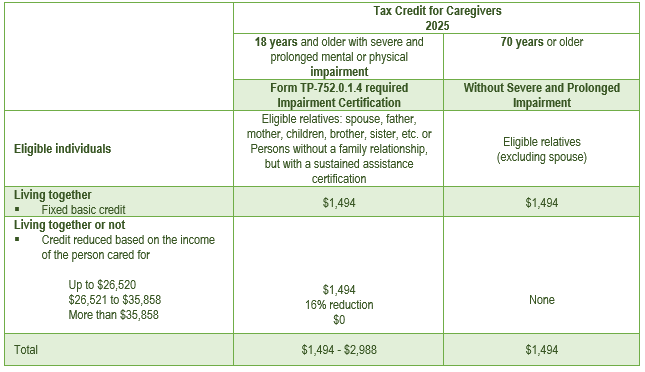
In Quebec, the scope of the tax credit for caregivers is not exclusively aimed at individuals with a severe and prolonged impairment. Indeed, the tax credit also allows for the inclusion of an elderly relative, other than a spouse, aged 70 and over who requires support.
The assistance is broken down into two parts:
- A fixed base amount of $1,494 in cases where the individuals live together.
- An additional amount of $1,494 (with or without cohabitation) in cases where the person has a mental or physical impairment. However, this amount is reduced by 16% of the net income of the person being cared for that exceeds $26,520.
Eligible Relative
An eligible relative generally includes a direct ascendant or descendant, a brother, sister, uncle, aunt, nephew, or niece. It may also include those of a spouse.
Non-Arm’s Length Person
A non-arm’s length person may be eligible provided that a healthcare professional certifies that the individual offers them sustained assistance.
Severe and Prolonged Mental or Physical Impairment
This criterion is generally met when the person requires assistance in carrying out a basic activity of daily living such as walking, feeding themselves, or getting dressed.
Sustained Assistance Certification Form (TP-1029.AN.A) :