Fiscal and Financial Planning Guide 2024-2025
Disabled Persons > Registered disability savings plans (RDSP)
The RDSP was created 15 years ago in 2008. Although it is one of the most advantageous programs, it is still little known and underused.
The RDSP is primarily intended for parents of children with physical or mental disabilities. The purpose of the program is to allow parents to set up a pension fund for their child with a disability so that they are not financially deprived in the future when the parents won’t be able to look after them. An RDSP can also be set up for a spouse with a disability.
Eligible Recipient
- Eligible for the Disability Tax Credit (federal T2201 form signed by a physician)
- Under 60 years of age
- Resident in Canada
Contributions
RDSP contributions are not tax deductible and therefore will not be taxable when withdrawn for the child. Contributions on the other hand qualify for generous grants that will be paid directly into the RDSP by the federal government.
Canadian disability savings grant (CDSG)
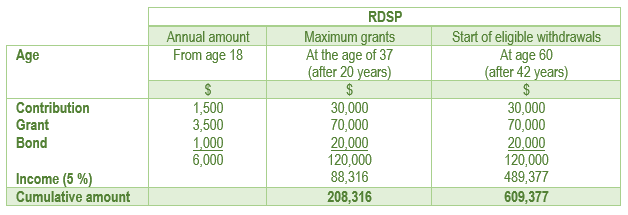
If the child is under the age of 18, grants are be based on the parents’ net family income. When the child reaches the age of 18, the grants are be based on the child’s net income, which will generally be lower than the family net income of the parents, leading to more generous grants. The schedule below shows the maximum annual grant amount of $3,500 when the net income is less than $111,733 or $1,000 if the income is more than $111,733. The maximum lifetime grant is $70,000.

Note that to determine the subsidy amount, CRA uses the net income of the second year preceding the current year. For example, for 2024, CRA uses income from the 2022 return.
Canadian Disability Savings Bond (CDSB)
In addition to the Grant, the Government will provide a Bond of $1,000 per year when net income is less than $36,502. The Bond is gradually reduced to $0 when income reaches $55,867.
As for the grant it is the family net income that is considered when the child is under the age of 18 and it is the net income of the child that is considered starting at age of 18.
Therefore, in the majority of cases, if the child’s income is less than $ 36,502 the annual bond of 1 000 $ can be paid to the RDSP starting at age 18 of the child.
The lifetime cumulative contribution maximum bond is $20,000.
Accumulation example
Withdrawls
Eligible payments begin at age 60.
If amounts are withdrawn before the age of 60, Grants and Bonds received in the previous 10 years must be repaid to the Government.
Payments will be taxable on the child’s declaration with the exception of the contribution portion which is not taxable.
The minimum withdrawal amount is based on a formula that depends on the age of the child.

Social Assistance benefits and RDSP
One concern that often comes up is the consequences that the RDSP could have on social assistance benefits that a beneficiary might receive.
During the accumulation period
Le Règlement de l’Aide aux Personnes et aux Familles specifically exclude the RDSP from the beneficiary’s assets. Thus, setting up an RDSP has no effect on the social assistance benefits during the accumulation period.
During the payment’s period starting at age 60.
According to Section III of the new Règlement de l’Aide aux Personnes et aux Famille, a beneficiary may receive in 2024 a monthly amount of $1,273 ($15,023/year) from the RDSP without affecting their social assistance benefit.
Thus, an amount of around $350,000 could be accumulated in the RDSP without affecting social assistance benefits, since the minimum annual withdrawal from the RDSP would be $15,225 (i.e. $350,000 x 4.35%), which corresponds to the social assistance exemption.
To reach this value of $350,000, if one start contributing $1,500 at age 18, he would need only 9 years of contribution until age 25, taking into account the $3,500 annual grant, the $1,000 annual bond and a 5% return.
Schedule
The following schedule summarizes the time schedule of an RDSP according to the age of the beneficiary:
