
Fiscal and Financial Planning Guide 2024-2025
Retirees > Québec Pension Plan (QPP)
History
The Quebec Pension Plan (QPP) came into effect in 1966. The contribution rate at the time was 1.8% for employees and 1.8% for employers. The maximum salary on which employees could contribute was $5,000.
As we’ll see later, things have changed a lot since then, as the government has made numerous modifications and improvements over the years of the plan’s existence. Indeed, in 2025, the contribution rate is 6.3% for employees and 6.3% for employers up to a maximum salary of $ 74,600 and 4% on the salary bracket between $ 74,600 and $ 85,000.
The successive increases in the contribution rate, whose main aim was to ensure the sustainability of the plan in the context of an aging population, have given rise to much debate over the years.
Indeed, the government wants to act like a good head of family by forcing workers to save for their retirement. But for many workers having an average income, compulsory QPP contributions reduce the personal saving amounts available for their RESPs, RRSPs, TFSAs or TFFHSA, which could enable them to adopt a savings strategy better suited to their personal situation.
Contributions
Contribution period
- Starts at age 18, calculated on earned income
- Ceases when workers stop working and no later than January 1 of the year in which the worker reaches age 73 if he continues to work.
- It is possible to stop contributing at age 65 when receiving a QPP pension.
Contribution rates
The following table illustrates the QPP contribution rate in 2025.
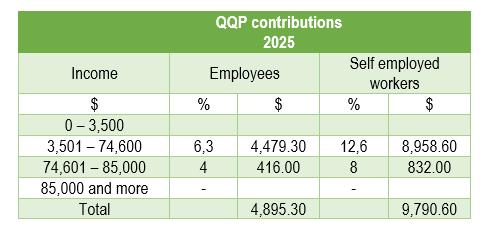
As you can see, contributions for a self-employed worker (maximum $9,790) are significantly higher than those for an employee (maximum $4,895), i.e. twice as much. Note that in the case of an employee, the employer pays the other half (maximum $4,895).
This is the case, for example, of an incorporated professional whose company pays him a salary. He will personally contribute $4,735 to the QPP, while his company will pay another $4,735.
Pension
Pension commencement
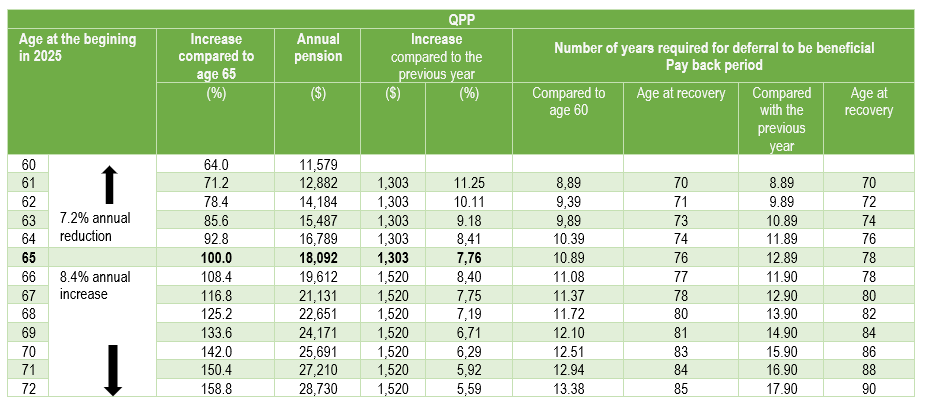
The QPP pension can be claimed no earlier than age 60 and no later than age 72, subject to a reduction of 6% per year of anticipation before age 65 and an increase of 8.4% per deferral year after age 65.
Pension amount
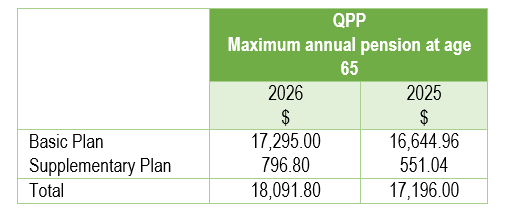
The normal retirement age under the QPP is 65. To be entitled to the maximum QPP pension of $ 17,196 in 2025, workers must generally:
- Have contributed for at least 35 years since the age of 18. Note that a mother with children under age 7 and earning less than $3,500 can subtract these years when calculating the 35 years required by the QPP so they won’t be penalized;
- Have earned the maximum QPP-eligible salary throughout their 35-year career since the age of 18. It should be noted that the QPP salary requirement of $74,600 in 2026 was $11,700 in 1979, the year in which a person aged 65 in 2025 was 18 (age at which contributions begin).
Maximum pension
The following table illustrates the maximum pension at age 65 ($17,196 in 2025) and the effect of the 7.2% annual reduction when claiming the pension before age 65 or the 8.4% annual increase when choosing to defer the pension after age 65.
Notes :
- These projections are in constant dollars (without indexation).
Increase in QPP maximum pensionable earnings
An additional component was added to the RRQ’s basic plan in 2024, under which employees contribute at a rate of 4% on an additional salary bracket ranging from $74,600 to $85,000, which is the maximum eligible earnings (MPE) (114% of the basic plan’s salary).
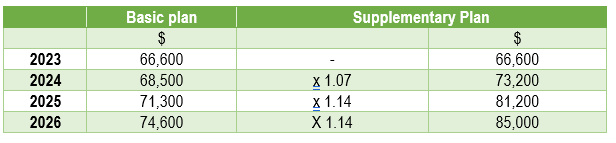
Workers earning more than the MPE will thus be entitled to receive higher pensions, and will also benefit from the gradual increase in the pension percentage from 25% to 33.33%. At maturity, younger workers earning $85,000 or more could therefore expect a pension of around $28,000 in today’s dollars (33% x $85,000), provided they have contributed enough years, generally 35 years.
Gradual increase in pension from 25% to 33% of pensionable earnings
Since its creation, the pension paid at retirement has corresponded to 25% of the average worker’s salary, subject to the maximum pensionable earnings ($74,600 in 2026).
Younger workers will benefit most from the increase in the rate based on the number of years of contributions.
Few workers are entitled to the maximum pension
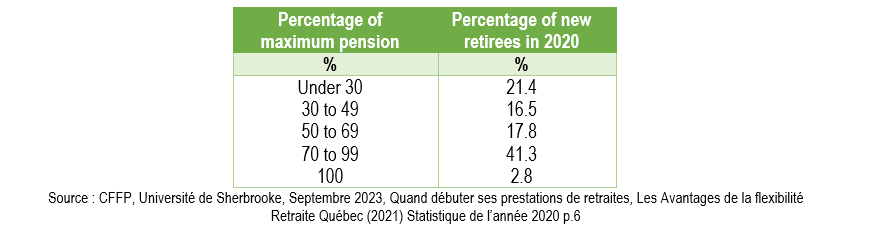
It is to be noted that only 2.8% of workers are entitled to the maximum QPP pension, as shown in the table below:
There are two main reasons for this:
- The maximum salary used by the QPP is the average industrial salary for large companies in Canada (200 employees or more) published annually by Statistics Canada. The average wage in Canada is about $10,000 lower than the average industrial wage used by the QPP. As a result, a majority of workers earn less than the salary required to obtain the maximum QPP pension.
- It is difficult to reach the required 35 years of contributions (late start of career after university, illness, remuneration in the form of dividends rather than salary by incorporated professionals, etc.).
To postpone the pension or not?
We could determine the ideal age from a financial point of view to claim the QPP pension if we could predict the future (e.g. age of death, inflation rate, effect of the pension on tax credits and other social programs).
Unfortunately, there are too many imponderables. This is a situation where forecasts can vary widely. In such a situation, it’s best to rely on certain basic principles.
Consider the number of years to recuperate deferred years
Another angle is to consider the number of years required for the higher pension obtained through deferral to recover the pension amounts sacrificed during the deferral period. Thus, as illustrated in the last column of the table, if we choose to take the pension at age 67, for example, it will take 11.4 years to obtain the same pension accumulation, i.e. at age 78. This is known as the pay back method.
It is important to note that:
- The previous projections shown in the table are intended as trends only. They do not take into account factors such as pension indexation, maximum increase in pensionable earnings, potential return on pension and tax implications.
- The table and examples have been prepared using QPP maximum pension amounts. As previously mentioned, few workers are entitled to the maximum pension. However, the reasoning remains the same for pensions below the maximum.
Consider the impact of annual annuity increases
Insuring survival risk
Delaying the start of your pension helps hedge against longevity risk—that is, it ensures a stable income if you are fortunate enough to live to an advanced age. As a guide, the table below shows the probability that a woman or man aged 65 in 2023 will reach a certain age. For example, a man aged 65 in 2023 has a 25% chance of reaching age 94.

Source : CFFP Université de Sherbrooke, Septembre 2023, Quand débuter ses prestations de retraite, les Avantages de la flexibilité p.14 IQPF Normes d’hypothèses de projection.
Pension protection at age 65
A retiree who chose to defer his or her pension after age 65 could suffer a negative impact on pension calculation due to the fact that he or she earned no work income during the deferral period and did not benefit from the full annual pension increase of 7.2% per year of deferral.
As of January 1, 2024, years of low or zero earnings during the deferral period after age 65 will no longer negatively affect the pension calculation. The retiree will also be able to benefit from the full annual pension increase of 8.4% per deferral year.
It is likely that, thanks to this new measure, more pensioners will differ the start of their pension after age 65.
Few retirees differ their QPP pension after age 65
Despite the recent increase in the deferral bonus to 8.2% per year after age 65, only 8% (6% + 2%) of retirees had chosen to defer their pension after age 65 in 2022. However, this proportion is higher than in 2017, when only 4% (3% + 1%) of retirees deferred the start of their pension after age 65.

One might even think that those who claimed it after age 70 had simply forgotten to claim it, since the option of deferring the annuity from age 70 to 72 was only introduced in 2024.
Pension cancellation
The pension can be cancelled within six months of the first payment if you change your mind and decide to defer it.
Enclosed is a link to form B-003, which must be used to submit the cancellation request :
https://www.rrq.gouv.qc.ca/en/services/formulaires/regime_rentes/Pages/b-003.aspx
Combined Public Pensions (OAS and QPP)
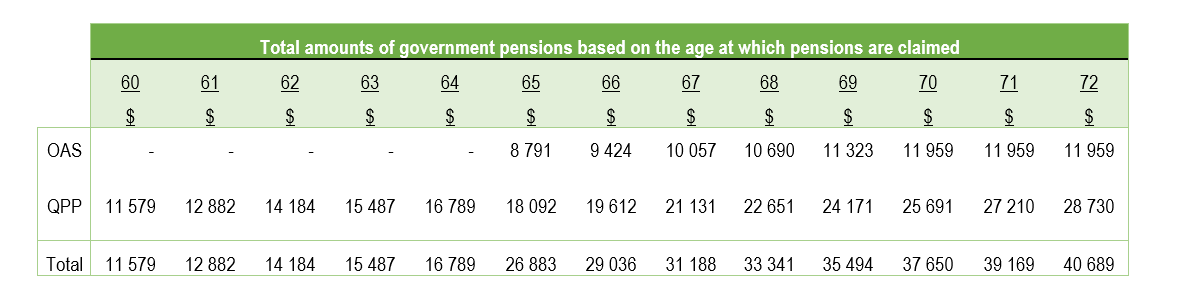
Many years ago, public pensions were often considered a relatively marginal element in retirement planning.
However, following the many improvements made to these plans over the years, they have become an increasingly important factor to consider.
Par exemple, une personne qui réclamerait les rentes à l’âge de 68 ans et qui aurait droit aux rentes maximum, recevait une rente annuelle de l’ordre de 33 000 $ (potentiellement le double pour un couple).
Please note that OAS amounts are those of 2025 and QPP amounts are those of 2026.