

Income Tax and Financial Planning News 2025-2026
With the new tax season upon us, here are the main income tax and financial planning developments for 2025-2026.
Enjoy your reading!
Table of Content
PDF Versions
General
Difficult times for the Canada Revenue Agency (CRA)
Auditor General’s Report on CRA Call Centers
On October 21, 2025, Auditor General Karen Hogan released her report on, among other subjects, the quality of services provided to taxpayers by the CRA’s 8 call centers for the 2024-2025 fiscal year.
Below are the highlights of the report.
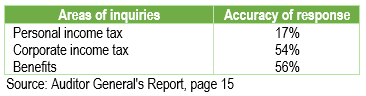
- Only 17% of answers to general questions about personal income tax were accurate
(54% for questions about business income tax).
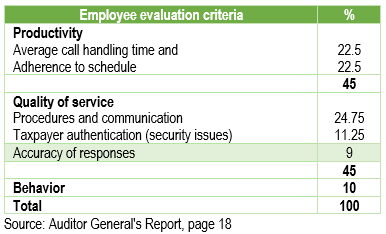
- One likely reason for the low rate of correct answers is that agent evaluations focused more on the respect of schedules than on the accuracy of answers. Less than 9% of agent evaluation scores related to the accuracy of information provided to taxpayers.
- The 8 call centers across the country received 32 million calls, of which only 10 million were answered by a CRA agent. In addition, in the fall of 2024, the CRA introduced call forwarding to the self-service option (interactive voice response system) without offering taxpayers the option of speaking to an agent.
- Although the number of calls increased by 30% between 2023-2024 and 2024-2025, the total number of calls handled by agents decreased by 17% over the same period. The increase in the number of calls is mainly due to:
- Population growth
- Complexity and frequent changes in tax measures
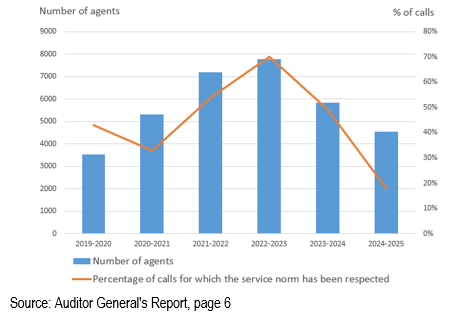
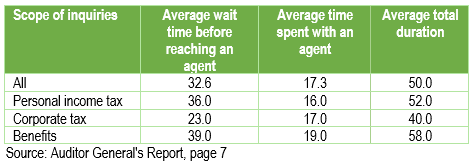
- The average wait time before speaking to an agent was 32.6 minutes, almost twice as long as the previous year. The goal was to be able to answer 65% of calls in less than 15 minutes. However, only 18% of calls were answered in less than 15 minutes.
- Administration of new tax measuresIn addition to the call center issues identified by the Auditor General, the CRA has experienced numerous problems in administering new tax measures.For example, we all remember the saga surrounding the proposed changes to the capital gains inclusion rate from 50% to 66.66%, which were never adopted. This caused harm to many taxpayers who anticipated selling stocks to avoid a possible increase in the inclusion rate.Another example is the requirement for Canadian companies owning real estate in Canada to file complex forms in 2023 relating to the properties they owned, even though the new measures were aimed at unrented properties owned by Canadian non-residents. The measure was amended the following year to exclude Canadian companies and was completely abandoned in 2025.In reports published in 2024-2025, the Joint Committee on Taxation formed by the Canadian Bar Association and Chartered Professional Accountants Canada expressed concern about the flurry of changes and called for the adoption of framework legislation with strict guidelines to prevent, among other things, the CRA from administering changes that Parliament has not yet adopted.Processing delaysSince the pandemic, there has been a slowdown in the processing of various types of follow-ups by the CRA.For example:
- Requests for tax return adjustments (up to one year)
- Follow-ups on audits conducted by the CRA
- Processing of notices of objection (up to two years)
Another problem arose during the 2024 personal tax season when the CONNECT system was not operational. This system is very useful to tax preparers, as it provides access to tax slips issued by employers (T4), financial institutions (T3, T5), governments (RRQ, PSV), etc. during the personal tax season.
Any improvement in sight?
Last fall, Federal Finance Minister François-Philippe Champagne asked the CRA to take concrete steps within 100 days to address taxpayers’ access issues and improve service quality. Let’s hope the message was heard.
Medical expenses
Starting January 1, 2026, only medical expenses for practitioners who are members of a professional order in Quebec will be eligible for the medical expense tax credit.
Thus, starting in 2026, the following expenses will be excluded, as they already were at the federal level.
- Homeopathy
- Naturopathy
- Osteopathy
- Herbalist
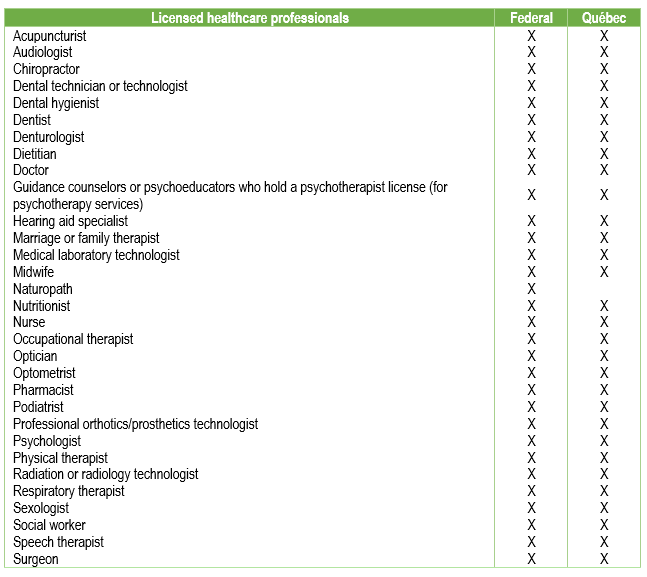
For the complete list, you can consult the CRA by clicking on the following link:
Political contributions (Quebec)
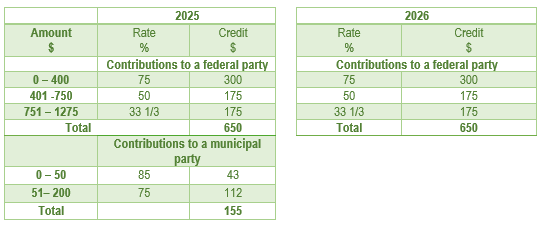
Starting in 2026, municipal political contributions will no longer be eligible for a tax credit. It should be noted that since 2013, political contributions to provincial parties have no longer been eligible for tax credits. Thus, starting in 2026, only political contributions to federal parties will be eligible for a tax credit on federal tax returns.
Luxury tax on aircraft and boats
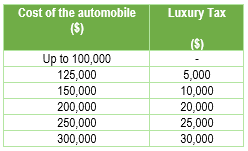
The federal government is abolishing the luxury tax on aircraft and boats acquired after the budget date, November 4, 2025. However, it remains in effect for automobiles.
The tax is equal to the lesser of:
- 20% of the amount over $100,000
- 10% of the value of the property
Tax on unused dwellings abolished
This measure, introduced in 2022 with the aim of reducing real estate speculation, will be eliminated as of 2025. It will therefore not be necessary to file Form UHT-2900E in 2025.
Production of personal tax returns by the CRA
Individuals must generally file a tax return to receive available benefits (e.g., Old Age Security pension) and credits (e.g., GST rebate).
To ensure that low-income individuals receive the benefits and credits to which they are entitled, the CRA plans to file their tax returns when all the following conditions are met:
- The individual’s taxable income is less than the basic personal credit amount ($16,129 in 2025).
- At least once in the previous three years, the individual did not file a tax return.
- The individual did not file a return for the last tax year as of June 30.
The CRA has access to all of the individual’s income.
Families
Parental union
It should be noted that the new parental union regime will automatically apply to common-law spouses who have children together born after June 29, 2025. This new measure is not retroactive, so couples who have children before that date will not be affected by the new Act.
Highlights of the new regime
- Parental union patrimony
The plan provides for the creation of a new parental union patrimony, the value of which can be shared 50%/50% between the spouses in the event of separation or death.
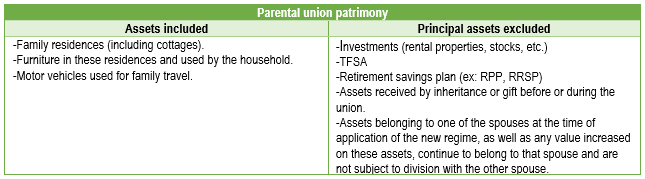
Unlike the Loi sur le partage du patrimoine familial or the Regime de société d’acquêts in the case of married couples, pension plans (RRSPs and employer-sponsored pension plans) are not covered by the new parental union plan.
- Temporary right to use the family home
In the event of separation, the spouse with custody of the children may remain in the family home for a certain period of time, to ensure a smoother transition for the children.
- Death
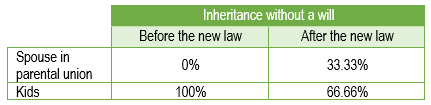
In the case of an estate without will (ab intestate), a spouse in a parental union will now be recognized as a legal heir if they have been living together for more than a year.
- Compensatory allowance
The new regime favors payment of compensatory payment rather than spousal support. In the event of separation or even death, a spouse may apply to the court for an allowance in recognition of his or her impoverishment due to his or her contribution to the enrichment of the other spouse.
- Renunciation to the new regime
The spouses will be allowed to renounce by mutual agreement in a notarial deed to the application of the provisions of the new plan within 90 days after the beginning of the parental union (i.e.: at the birth of a child after June 29, 2025). In this case, parental union patrimony is presumed never have been constituted.
Spouses in a parental union will also be able to choose by mutual agreement in a notarial deed to exclude certain assets otherwise included in the parental union patrimony (e.g. residences, furniture, automobiles).
Childcare expenses (Quebec)
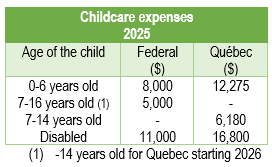
In his March 25, 2025 budget, Quebec’s Finance Minister Eric Girard announced that the age of eligibility for the child care tax credit will be reduced from 16 to 14 starting in the 2026 tax year.
Parental Leave
FMSQ
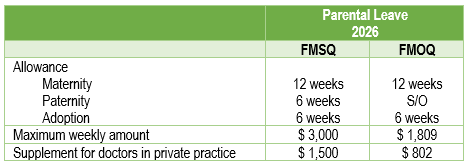
Weekly maternity leave benefits will increase from $2,400 to $3,000 per week in 2026 for a maximum of 12 weeks. The supplement for physicians practicing in private practice will increase from $1,000 to $1,500 per week for a maximum payable of 12 weeks.
In addition, paternity (or parent who did not give birth) and adoption benefits are also available at a maximum weekly amount of $3,000 for a period of 6 weeks.
FMOQ
Maternity benefits remain at $1,809 per week for 12 weeks.
The supplement for physicians in private practice is $802 per week for 12 weeks.
Please note that the FMOQ does not offer paternity leave.
Futur owners
GST and QST refunds on new housing
First-time buyers of new homes
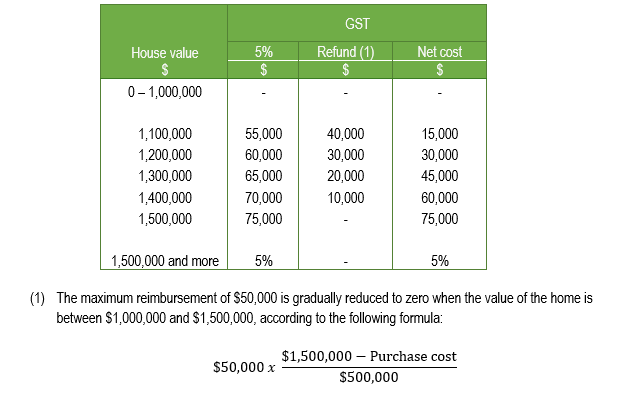
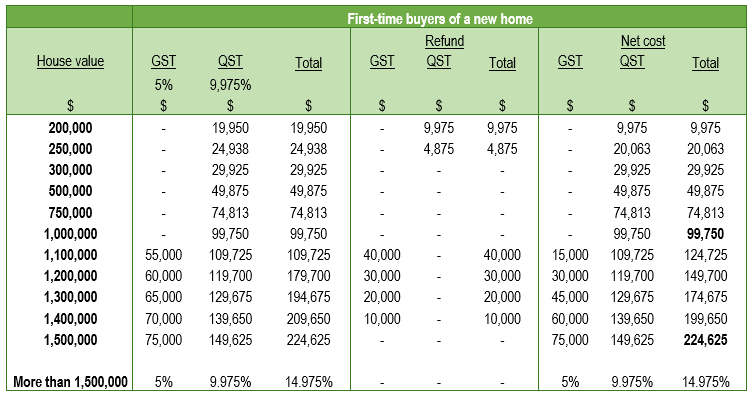
On May 27, 2025, the Minister of Finance of the federal government, the Honorable François-Philippe Champagne, announced that the federal government is eliminating the 5% GST for buyers of a new first home valued at less than $1 million, representing a maximum saving of $50,000 ($5% x $1,000,000).
For homes valued between $1 million and $1.5 million, buyers will be entitled to a rebate that will gradually decrease to $0 when the value of the home reaches $1.5 million.
This measure is intended to reduce the cost of buying a first home and stimulate new home construction. It is one of a series of recent measures to facilitate first-time home purchases, such as the introduction of the TFSA and the increase in the Home Buyers’ Plan (HBP) limit to $60,000.
The following table illustrates this new measure.
Eligible individuals
To be eligible for the new program, an individual must generally:
- Be at least 18 years of age;
- Be a Canadian citizen or permanent resident of Canada;
Not have lived in a home in Canada or abroad that they or their spouse owned in the previous year or in any of the previous four calendar years.
Eligible dwellings
The following conditions must generally be met:
- The buyer intends to make this dwelling his or her primary residence;
- In the case of a purchase, the contract is signed between May 27, 2025 and December 31st, 2030 and construction begins before 2031 and is completed before 2036;
- In the case of a home built by the owner, construction began between May 27, 2025 and December 31st, 2030 and is substantially completed before 2036.
Quebec (QST)
The Quebec government has not announced any changes to the provincial sales tax (QST) rebate program for the purchase of new homes.
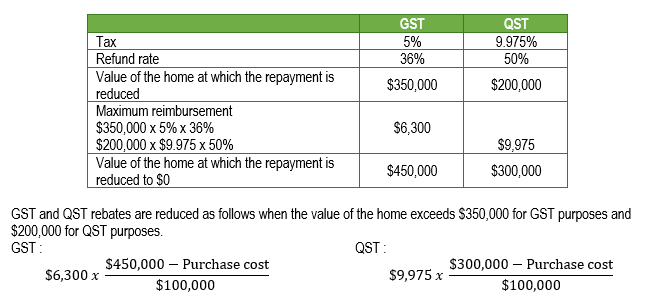
Under current rules, buyers of new homes valued at $200,000 or less are entitled to a 50% QST rebate. The maximum rebate of $9,975 ($200,000 x 9.975% x 50%) is gradually reduced for homes valued between $200,000 and $300,000.
The following table illustrates the amount of GST-QST for first-time buyers of a new home considering the effect of the new federal measure.
Buyers of a new home that is not their first home
Buyers of a new home that is not their first home are entitled to the following refunds:
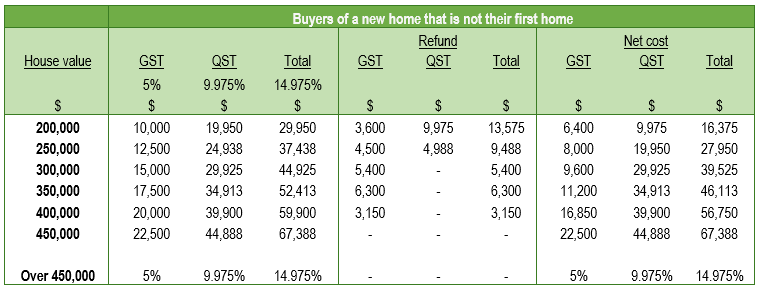
The following table shows the combined GST-QST amount for a buyer of a new home that is not their first home, based on the value of the property:
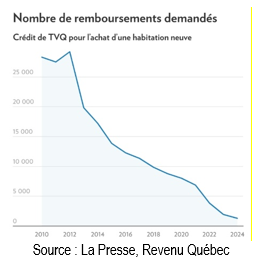
Following the increase in house prices, the following graph shows that the number of requests for refunds is trending downward, given that refunds are reduced starting at a value of $450,000 at the federal level and $300,000 in Quebec.
We note indeed that the annual number of QST refund claims has fallen from over 25,000 in 2010 to less than
2,500 in 2024.
Eligible dwellings
The property must be purchased to serve as the primary residence of one of the buyers or one of their relatives.
For example:
- Child, grandchild;
- Father, mother, grandfather, grandmother;
- Brothers, sisters.
Property value
For the purposes of calculating the GST or QST rebate, the value of the property takes into account the following items, where applicable:
- Built-in appliances
- In-ground swimming pools
- Attached garages
- Landscaping
It should be noted that a GST/QST refund may be requested for a duplex in which the buyer resides, but the total value of the duplex must be taken into account for calculation purposes, which generally reduces the potential refund to zero.
Refund requests
Property purchased from a builder
- Request by the manufacturer
It is usually the manufacturer who makes the request and reduces the purchase price accordingly. In this case, the manufacturer completes form FP-2190.AC and has it signed by the buyer.
- Request by the buyer
Form FP-2190.P must be submitted to Revenu Québec within two years of the transfer of ownership.
Property built by the individual themselves
Form FP-2190.P must be filed with Revenu Québec within a period following the day on which the owner begins to occupy the property.
Investments
Alternative minimum tax (AMT)
Remember that the new rules for calculating the alternative minimum tax (AMT) came into effect in 2024.
These rules affect mostly individuals who realize significant capital gains, as illustrated in the table below.
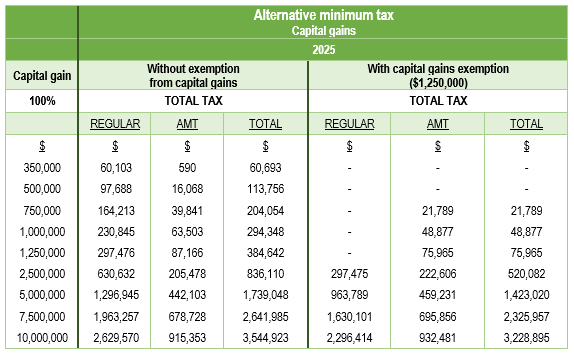
Remember that the additional tax owed to the AMT can be recovered in the subsequent years if the regular tax exceeds the minimum tax during the year.
In addition, it should be noted that the AMT does not apply to the year of death.
Other examples of situations where the AMT could apply:
- Purchase of significant amounts of flow-through shares
- Trusts that deduct interest expenses
Obligation to report foreign property (Quebec – Form TP-1079.8.BE)
Starting in 2025, the Foreign Property Return form (TP-1079.8.BE) must be completed when holding foreign property with a total cost exceeding $100,000.
The rules are essentially the same as those for filing the federal Foreign Income Verification Statement (T1135) form, which has been in existence for nearly 30 years (since 1997).
Both forms are filled with the personal tax returns.
Abolition of the additional capital gains exemption on flow-through shares
The additional capital gains exemption is abolished for sales of flow-through shares made after March 25, 2025.
It should be noted that this capital gains exemption could be claimed, within certain limits, on the sale of flow-through shares issued by companies engaged in mining operations in Quebec.
In addition, additional deductions for certain mining exploration expenses in Quebec are eliminated for flow-through share sales made after March 25.
Retirees
Tax credit for career extension
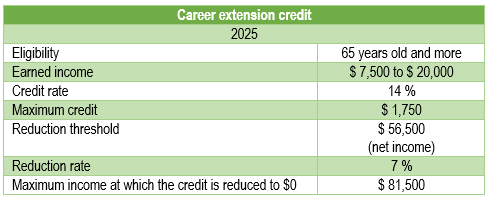
Starting in 2025, workers aged 60 to 64 will no longer be eligible for the tax credit for career extension. The following table illustrates the terms and conditions of the non-refundable credit for workers aged 65 and over, which has a maximum value of $1,750.
Advance life deferred annuity (ALDA)
This is not entirely new. Although this new tax strategy has been available since January 1, 2020, it was not offered by insurers until recently. To our knowledge, only Desjardins Assurance offers this program at this time.
Goal
The aim of this new measure is to insure, in terms used by an actuary, the survival risk, i.e. the risk of living a long life. It is somewhat ironic to describe the chance of living a long life as a “survival risk.”
Operation
This new measure allows for a tax-free withdrawal from an RRSP or RRIF to purchase a deferred life annuity starting no later than age 85.
It should be noted that the purchase of a deferred life annuity can also be made by withdrawing from a Profit Sharing Plan (PSP) or a Defined Contribution Pension Plan.
Limits
The maximum amount that can be withdrawn from an RRSP or RRIF is the greater of:
- 25% of the value of the RRSP
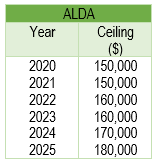
- $180,000 in 2025
The $180,000 limit is indexed in increments of $10,000 based on the consumer price index. Since its introduction in 2020, the limit has increased as follows:
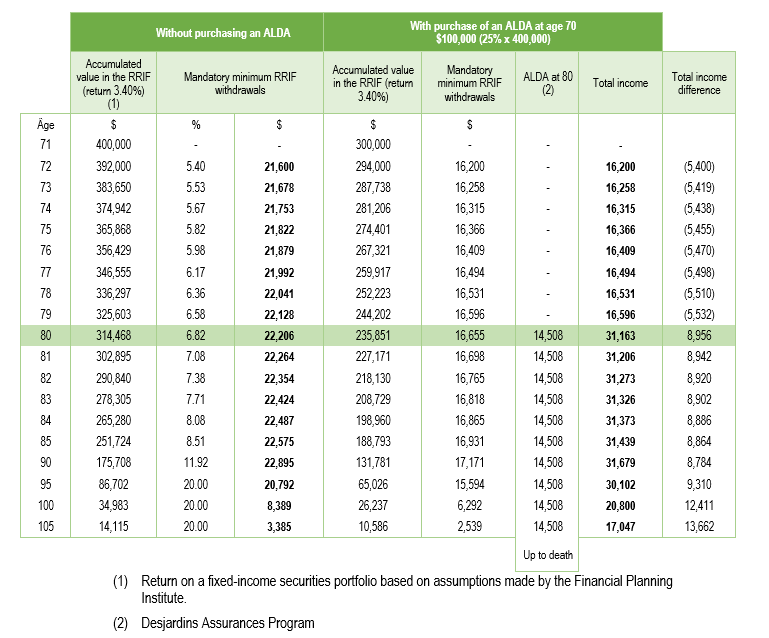
An increase in a deferred life annuity could be considered when converting an RRSP to a RRIF for individuals who do not need the full amount of the minimum withdrawals required from the RRIF. Remember that RRSPs must be converted to RRIFs no later than December 31 of the year in which a person reaches age 71. The first mandatory RRIF withdrawals (5.40% of the RRIF value) begin in the year following the transfer from the RRSP to the RRIF.
The following table illustrates the impact of this strategy based on the following assumptions:
- Couple aged 70 in 2025
- Purchase at age 70 of a deferred life annuity for an amount of $100,000, or 25% of the $400,000 RRIF
- Payments deferred for 10 years, beginning in 2035 (payable to spouse in case of death)
- Conversion of RRSP to RRIF at age 71
- Start of mandatory minimum withdrawals at age 72
- Return of 3.40% on RRIF investments
Deferred life annuities (Desjardins Assurances Program)
The annuity must be purchased before the year in which the annuitant reaches age 71 (except for transfers from a RRIF, which can be done later).
Annuity payments must begin no later than the end of the year in which the annuitant reaches age 85.
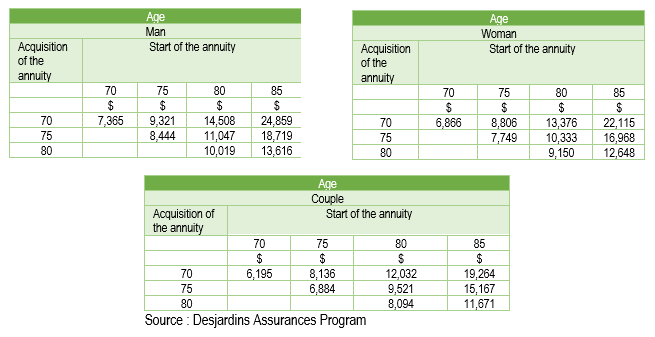
The following tables provide examples of life annuities that could be purchased with $100,000 in capital.
It is important to note that these have been calculated based on economic conditions existing in January 2026 and that annuity amounts purchased in the future may differ depending on market conditions at the time of purchase.
Once the annuity has been purchased, the differed annuity amount will not vary based on market conditions.
Payback Period
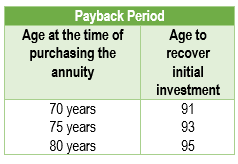
How many years of payments are required for a deferred annuity to recover the initial capital invested?
Assuming that the initial capital and the annuity payments are invested at a rate of return of 3.40% (fixed income), the initial capital would be recovered approximately between the ages of 91 and 95, depending on the age at which the annuity was purchased.
Strategies
Deferred annuities could be considered mainly in the following situations.
- Preserve the Old Age Security Pension (OAS)
Purchasing a deferred life annuity could be advantageous if it reduces the partner’s net income that would fall within the OAS reduction zone, i.e., from $93,454 to approximately $155,000.
This is because, above this threshold, the Old Age Security (OAS) pension is gradually repaid based on individual net income when tax returns are filed, and is completely repaid when net income reaches approximately $155,000. The tax rate on amounts earned in this income bracket ($95,000 to $150,000), taking into account the effect on the OAS reduction, is in the range of 50% to 55%, considering the effect of the OAS slope.
- Stabilize income in the event of the death of a spouse
Following the death of the first spouse, the deferred annuity could help compensate for the couple’s loss of income in order to provide security for the surviving spouse.
- Cover additional costs associated with advanced age
- Home adaptations following a loss of independence
- Housekeeping and landscaping
- Personal and medical care
- Preparing for home support
- Etc.
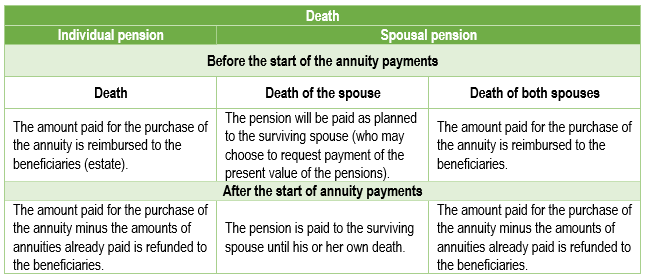
It should be noted that in all cases of death, the retiree and/or the estate will recover at least the capital invested in the purchase of the deferred annuity, either in the form of annuity payments already received and/or a refund.
Penalties
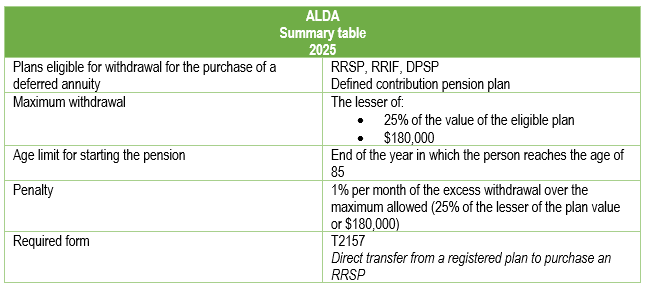
A penalty of 1% per month applies to the amount withdrawn from the RRSP to purchase the deferred annuity that exceeds the maximum amount allowed, which is the lesser of:
- 25% of the value of the RRSP
- $180,000 (in 2025)
Form T2157
In order to complete the transfer to acquire the annuity, form T2157 must be completed:
https://www.canada.ca/en/revenue-agency/services/forms-publications/forms/t2157.html
Quebec Life Income Fund (LIF)
Abolition of maximum withdrawal limits starting at age 55
What is an LIF?
First, let’s review the circumstances under which an LIF is generally established.
A worker whose employer is under Quebec jurisdiction and who leaves his or her job may, under certain conditions, transfer the accumulated value of their employer’s pension plan to a personal retirement vehicle.
The funds will then be transferred to a locked-in retirement account (LIRA). Upon retirement, the funds may be transferred from the LIRA to the LIF, among other options.
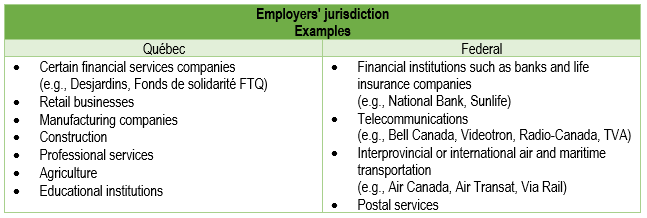
Employer under Quebec or federal jurisdiction?
Please note that the following comments concern LIFs for workers whose employer is under Quebec jurisdiction, which represents the majority of businesses in Quebec. For example, retailers, manufacturers, professionals, builders, etc.
Companies operating in sectors such as financial institutions, transportation (air, marine), postal services, and communications are under federal jurisdiction, and other rules apply.
Mandatory withdrawals from the LIF
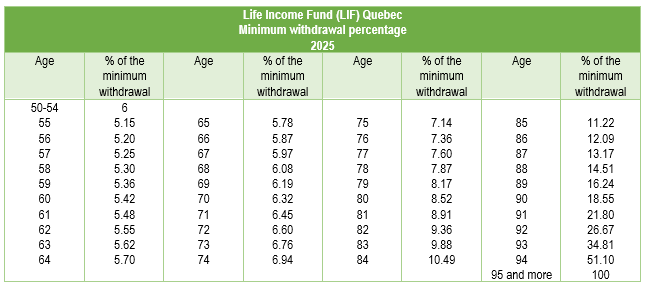
Once the funds have been transferred to the LIF, mandatory minimum and maximum withdrawals begin.
Until 2024, maximum withdrawals from the LIF starting at age 55 were around 5% and gradually increased with age to reach nearly 10% at age 80 and 20% at age 90.
This new measure is generally welcomed by financial advisors, as it will offer more flexibility in retirement income planning. For example, for pension income splitting or to allow individuals to defer public pensions (QPP and Old Age Security).
The following table illustrates the minimum withdrawal percentages relative to the value of the LIF according to age.
It should be noted that CRI funds could also be used to purchase a life annuity rather than transferring them to an LIF.
Other considerations
- Financial institutions that manage LIFs will be required to provide the following information to their clients aged 55 and over as of January 1, 2025:
- Elimination of maximum withdrawal limits
- An estimate of the annual lifetime income that could be generated from their LIF to give an indication of the annual amount they could receive over their lifetime if they comply with this amount
- Inability to transfer funds directly from the LIF to an RRSP or RRIF. The purpose of this measure is to maintain the priority of transferring funds to a spouse in the event of death
- The LIF de-immobilization strategy commonly known as “Flip Flop” will no longer be permitted and will be unnecessary in any case given the abolition of maximum withdrawal limits. We welcome the disappearance of this strategy. In fact, we generally found it to be of little use and it was often the subject of tax audits, which resulted in numerous penalties for excess RRSP contributions due to the difficulty of tracking RRSP carry-forward balances by both individuals and their accountants.
Individuals under the age of 55
The maximum FRV withdrawal limit for individuals under age 55 is increased to 50% of the Maximum pensionable earnings for QPP purposes which amount to $35,150 (50% x $ 71,300) in 2025, minus 100% of other income for the year.
LIF federal jurisdictions
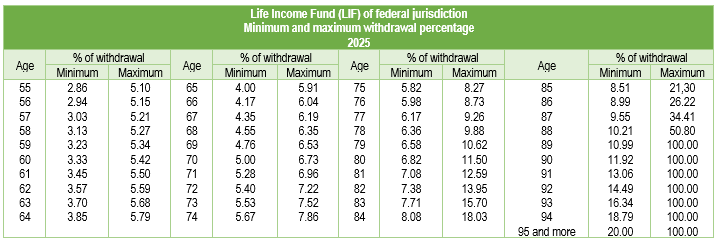
Federal jurisdiction LIFs remain subject to maximum withdrawal limits, unlike Quebec LIFs, which no longer have maximum withdrawal limits after age 55. The minimum withdrawals from an LIF are identical to those from a Registered Retirement Income Fund (RRIF).
Elders
Home Accessibility Tax Credit
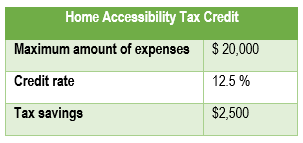
Starting in 2026, expenses eligible for the medical expense credit will no longer be eligible for the home accessibility credit for people aged 65 and over.
Remember that the following expenses are eligible for the home accessibility credit:
- Ramps for wheelchairs;
- Bathtubs with doors;
- Grab bars;
- Mechanical stair lifts.
Expenses for routine maintenance (painting, housework), renovations, or furniture purchases are not eligible.
Disabled persons
Canada Disability Benefit ($200/month)
To help people with disabilities who face additional expenses due to their situation, the federal government has introduced the Canada Disability Benefit (CDB).
Amount of the benefit
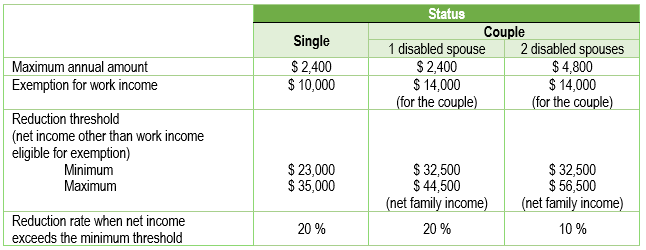
The maximum amount of payments is $200 per month, for a total of $2,400 per year, payable starting in July 2025.
It should be noted that the benefit is non-taxable and should not affect other programs offered by the federal government or the province of Quebec.
Eligibility for benefits
The main eligibility criteria are as follows:
- Be approved for the Disability Tax Credit (DTC – Form T2201)
- Be between 18 and 64 years old
- Be a Canadian resident
- Have filed a tax return
Income-based reduction of benefits
The amount of the benefit is gradually reduced when net income exceeds certain thresholds, as illustrated in the following table.
To submit a request
You can submit a request in one of the following ways:
- Call 1-833-486-3007
- Complete form SC CDB0004 or CDB0005 (if completed by a legal representative)
o Online: https://catalogue.servicecanada.gc.ca/content/EForms/fr/Detail.html?Form=CDB0004
o Fax: 1-833-467-2700
o Mail to:
Service Canada Center
PCPH Processing Center
P.O. Box 60
Boucherville, QC
J4B 5E6
Once approval has been obtained, payments can be made retroactively for a period of 24 months from the program’s effective date (July 2025).
You will mainly need the following information:
- Social Security number
- Net income from your 2024 tax return (line 23600)
If the request is made by a legal representative, proof of authorization must be provided.
For example:
- Court order
- Protection mandate
- Identification document (e.g., driver’s license, passport)
- Correspondence from an organization that recognizes you as a legal representative
Finautonome
Below is a link to the Finautonome website.
Finautonome is a non-profit organization whose mission is to support people with disabilities and caregivers in the ___ of the various people available (social assistance, taxation, RDSP, etc.).
